

Happiness Hypothesis is good!
I read, a lot. At least one book a week, often more.
My list of non-fiction books I've read but need to review is currently 43 and of that list the Happiness Hypothesis: Finding Modern Truth in Ancient Wisdom is in my top five. Also, of that list, this is one of only three books I've read twice.
The author Jonathan Haidt takes a lifetime of philosophical pursuit into the meaning and maximization of life, combines it with decades of personal scientific inquiry into moral psychology, and uses as its base recent advances in positive psychology. To keep this review succinct, I'll be focusing on just three of its eleven chapters. I highly encourage you to get the book and check out all the other chapters yourself!

The Elephant & The Rider
The first step towards making significant change is acceptance. A common idea written about throughout positive psychology, cognitive science, social psychology, and behavioral economics is that the world is not as it seems – we as conscious, thinking humans are much less conscious than we believe.
We make New Year's resolution and are not surprised when we fail. When we decide to exercise, lose weight, spend more time at home we go. at it guns blazing for a few days and all to often fall back to our old ways. If we stop watching TV for a few days we may act different, but with no surprise, we bend back into our old habits.
The Happiness Hypothesis (Check it out!) gives this occurrence a name – the elephant & the rider.
“Modern theories about rational choice and information processing don’t adequately explain weakness of the will…. The image that I came up with for myself, as I marveled at my weakness, was that I was a rider on the back of an elephant. I’m holding the reins in my hands, and by pulling one way or the other I can tell the elephant to turn, to stop, or to go. I can direct things, but only when the elephant doesn't have desires of his own. When the elephant really wants to do something, I’m no match for him.”
Acceptance is the first step because once we acknowledge the true complexity of consciousness, instead of trying and failing to whip the elephant to our will, we can gently nudge it to greater and more permanent effect. What's needed to implement massive personal change isn't massive willpower – it's just the right set of tools.
Meditation, Prozac, & Cognitive Therapy
The Happiness Hypothesis (Check it out!) is like a mystery novel – the author explores a series of suspects, one by one, hoping that each, in turn, is the answer to the question, “What's the best path to sustained happiness?” The first suspect was meditation, followed by Prozac and cognitive therapy.
 | Meditation– with more than 2,000 years of development and 500 million to one billion adherents, Buddhism, the source of meditation, is big and old. Buddhism teaches the idea of non-attachment. As we cannot fully control our external environment, Buddhism suggests that humans reject the outside world and generate happiness from within. Some of the tenants of this philosophy/religion have been scientifically validated: much of our life is a never-ending rat-race; despite our effort and focus, much of what happens to us is outside our control; and happiness can be reliably generated from within. Nevertheless, positive psychology suggests Buddhism may have taken the idea of non-attachment to its extreme –
|
 | Prozac– if you could put something in your mouth that makes you happy but requires no effort, would you? If you're like the vast majority of Americans, your answer is a clear no. You don't believe in shortcuts. Except that you're probably taking one every day. You're probably eating some sweet, fatty, and otherwise unhealthy food that brings you pleasure when you put it in your mouth. Why not take something even better? Prozac can increase levels of happiness, both for those that are depressed and for those that aren't. The author took Prozac, loved its effect (he says he had the rosiest disposition ever in his life), but choose to discontinue its use due to the side-effects. I agree with the author – if there were no side effects, I might take this pill. Is it truly evil to be happier, act kinder, see more optimistically, and give more love? Luckily, we can defer the moral calculus – a true happiness pill is decades or more away. |
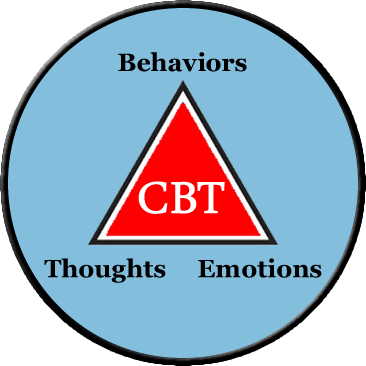 | Cognitive Therapy– it's something that some of us have heard of… as a treatment for the depressed. One of the first lessons Positive Psychology has shared, in the form of Martin Seligman's second book, Learned Optimism, is that joy and happiness can be permanently increased by changing our thought patterns. We're not talking about suppressing negative thoughts – that's dangerous and a recipe for stress and disaster. Cognitive therapy is something more difficult, actively changing our thought patterns. To give a personal example, for all of my life there are certain very annoying things my family members have said to me. I actually tense up each time they say these things to me because I'm suppressing my negative mental reaction, because if I had ever talked back as a kid it wouldn't have been pretty, and now that they've been saying it for decades, no matter how much I protest now they keep on saying it. I tried all sorts of things – talking to them about it, taking deep breathes, but nothing has worked. Cognitive therapy did. Now, when they say something that generates a negative thought, I catch myself in the act of mentally cringing, stop myself from having negative self-talk, and replace it with something positive – “oh, they're just saying that because they care so much about me, how sweet.” Now when they call, I can pick up the phone and smile. It took a few months and dozens of repetitions, but it worked. |
H = S + C + V (Happiness Equation)
As simple as the above answers may be, they were nothing more than pieces of the final answer. The second developed hypothesis that the author considered was:
Happiness (H) = Biological set point (S) + Conditions of your life (C) + Voluntary Activities (V)
Biological Set Point (S)
The biological set point, unfortunately for those that weren't born with bundles of joy and enthusiasm (like myself), is an extremely strong beginning –
“Twin studies generally show that from 50 percent to 80 percent of all the variance among people in their average levels of happiness can be explained by differences in their genes rather than in their life experiences.”
That's right – 50% to 80% of our life happiness is explained by genetic factors, essentially outside of our control. Fortunately, the reason this blog exists is that science has also validated that there are proven ways to permanently increase our happiness.
Conditions of your life (C)
It's not by getting that new car or big house you've been dreaming of. Because we quickly adapt to new things, new toys, furniture, electric devices, homes, refrigerators and like bring us increased joy for a few days, weeks, or months, and then that's it. Three life conditions that really matter:
- Commuting: “Many people choose to move farther away from their jobs in search of a larger house. But although people quickly adapt to having more space,36 they don’t fully adapt to the longer commute, particularly if it involves driving in heavy traffic. Even after years of commuting, those whose commutes are traffic-filled still arrive at work with higher levels of stress hormones.”
- Lack of control: “In a review paper that Rodin and I wrote, we concluded that changing an institution’s environment to increase the sense of control among its workers, students, patients, or other users was one of the most effective possible ways to increase their sense of engagement, energy, and happiness.”
- Relationships: “The condition that is usually said to trump all others in importance is the strength and number of a person’s relationships. Good relationships make people happy, and happy people enjoy more and better relationships than unhappy people. Conflicts in relationships—having an annoying office mate or room-mate, or having a chronic conflict with your spouse—is one of the surest ways to reduce your happiness. You never adapt to interpersonal conflict; it damages every day, even days when you don’t see the other person but ruminate about the conflict nonetheless.”
Voluntary Activities (V)
There are three classes of voluntary activities that have been shown to consistently increase levels of happiness:
- Expressing gratitude and kindness is a way to fight adaption effects. If we start taking something good for granted, it stops giving us joy. If we express gratitude, we can reverse that process: “Studies that have assigned people to perform a random act of kindness every week, or to count their blessings regularly for several weeks, find small but sustained increases in happiness. So take the initiative! Choose your own gratifying activities, do them regularly (but not to the point of tedium), and raise your overall level of happiness.”
- Meditating and employing mindfulness techniques to enjoy the present, rather than ruminating on the past or stressing about the future can boost mood, both in the short term, but especially in the long term.
- Engaging in flow and pursuing our strengths has been associated with increased levels of satisfaction. Specifically, “Seligman proposes that V is largely a matter of arranging your day and your environment to increase both pleasures and [flow activities].” See here for a description of flow.
 Conscious Pursuit of Happiness
This book review of Happiness Hypothesis (Check it out!) has turned more into a summary.
This was to be expected given the rich collection of information the book contains. I highly recommend you check out the entire book yourself. It is one of the key books on happiness. A “must read” Let me finish with what I think is the book's most powerful quote:
“The elephant cares about prestige, not happiness, and it looks eternally to others to figure out what is prestigious. The elephant will pursue its evolutionary goals even when greater happiness can be found elsewhere. If everyone is chasing the same limited amount of prestige, then all are stuck in a zero-sum game, an eternal arms race, a world in which rising wealth does not bring rising happiness. The pursuit of luxury goods is a happiness trap; it is a dead end that people race toward in the mistaken belief that it will make them happy.”
– Excerpt from Happiness Hypothesis
If you want to be happier, happiness hypothesis is one of the best books for you. It really gets into the specifics of the science. Not glossing over the idea in some shallow manner. If you . have read my other book reviews you know I often find major elements with books I dislike, even if I give them a careful ovrall recommendation, I rarely “gush”. That should tell you that this book is truely worth your time.
[thrive_link color='orange' link='https://amzn.to/2JW5atw' target='_self' size='big' align='aligncenter']Check it out on AMAZON[/thrive_link]